House of Blues Radio Feature on Roy Rogers July 11th & 12th

Start your engines and listen to the House of Blues Radio Hour nationwide on July 11th and 12th where Roy Rogers will be interviewed talking about the new release 'Split Decision and and aired nationwide!  Spread the word!

New Release Hits The Charts, Guitar Player Feature & Free Download!

          "It's a signature project..."  ~  Billboard

Roy Rogers' new release "Split Decision"  is gaining great momentum and has climbed to the #10 position on the Billboard Blues Charts, #4 on the Roots Blues Music Charts, and #12 on The Living Blues Chart.  AAA and Americana Charts to be announced next week. Keep those calls coming in to the stations in your area - it helps!  And thank you!

Get your copy of the July issue of Guitar Player Magazine where Roy is interviewed about the new recording.  In addition there is a Free download available in the Music Store in the 'Split Decision' area of the track 'Requiem of a Heavyweight" as an free MP3 - enjoy and please share!  And of course, get your copy on Amazon, the Blind Pig website, or right here in our Music Store.

Here's some of the recent press raves about the new release:

“New age phenomenon Ottmar Liebert pops up on the virtuoso slide guitarist’s first studio album with his band, The Delta Rhythm Kings in seven years.  Rogers opens with a raucous ‘Calm Before The Storm’, then moves through a diverse set of jazz-inflected blues tunes...”  ~  USA Today

“Slide guitar whiz Roy Rogers has a strong album with "Split Decision," and it's a signature project... The album opens at a furious pace with "Calm Before the Storm," a wall-of-sound number punctuated by Rogers' stinging slide guitar. - Billboard

“Split Decision includes some of the strongest songwriting of Rogers’ career and a dazzling array of guitar tones.”  ~ Offbeat

“Slide guitar ace Roy Rogers wowed a packed house in the blues tent (New Orleans Jazz Festival) with new Little Queen Bee and Calm Before the Storm (sung by son Sam),
a sizzling version of Robert Johnson's Terraplane Blues and rousing tunes with pianist Marcia Ball.”  ~  USA Today

“Rogers is not only a fine musician and producer, he knows how to write then deliver each track with just as much emotion with singing as playing. This music is like the deadly venom of a rattlesnake bite, the kind that feels good, like sweet pain but it spares your life in the end and gives you the blues so you get try to dodge the bullet just one more time.” - E Jazz News

“ Rogers is such a monster slide guitar player he’s mentioned with the likes of Sonny Landreth or legends like Robert Johnson. A slide-guitar aficionado’s dream come true.”   - Houston Press

“The man plays slide like Big Ben plays football...  ~  Pittsburgh Post-Gazette

More to come very soon!  All the best ~  Gaynell

Roy Rogers' New Album
The first studio recording from Roy and the band in 7 years this one is eclectic Americana and contemporary blues recordings at its finest. Edgy guitar tracks, deep grooves, tense rockin' blues and ballads. Surprises include jazz instrumentals....
Roy Rogers' Split Decision
There is nothing like a good blues-rock album to get your blood circulating and if it’s good enough it can serve as aphrodisiac. In the case of the first Roy Rogers album with The Delta Rhythm Kings in seven years, all of the above are applicable. [Read More...]
Roy Rogers' Split Decision
Slide guitar whiz Roy Rogers has a strong album with "Split Decision," and it's a signature project. [Read More...]
Roy Rogers' Split Decision
There is nothing like a good blues-rock album to get your blood circulating and if it’s good enough it can serve as aphrodisiac. In the case of the first Roy Rogers album with The Delta Rhythm Kings in seven years, all of the above are applicable.

Split Decision is well crafted for more than your typical hot blooded blues audience, this has some gripping songwriting and outstanding guitar playing, most notably some blistering slide with both acoustic (“Your Sweet Embrace”) and electric (“Patron Saint of Pain” and several others) that would appeal to a wide array of listeners.
[Read More...]
Jazz Fest on The Upswing
NEW ORLEANS — Veterans, lathered in SPF 30, clutching a daily lineup with scribbled priorities and lugging nothing heavier than a folding camp chair, can always spot the newbies. They're the ones with sunburned limbs, stiff footwear and iPods. The common ground? Mile-wide smiles, ringing eardrums and grease-stained T-shirts.

Slide guitar ace Roy Rogers wowed a packed house in the blues tent with new Little Queen Bee and Calm Before the Storm (sung by son Sam), a sizzling version of Robert Johnson's Terraplane Blues and rousing tunes with pianist Marcia Ball.

[Read More...]
Roy Rogers: Slide Guitarist Extraordinaire

Roy Rogers has been playing the blues for over 30 years. Known as one of the leading slide guitarists in the world as well as for producing records for John Lee Hooker and Ramblin’ Jack Elliott, Rogers is the epitome of the modern traveling blues musician, playing gigs big and small throughout the world. Recently, he released "Split Decision," which he describes has having a bit more “edge” than his previous recordings. [Read More...]
Pollstar: Roy Rogers: Slide Guitarist Extraordinaire


Roy Rogers: Slide Guitarist Extraordinaire

Roy Rogers has been playing the blues for over 30 years. Known as one of the leading slide guitarists in the world as well as for producing records for John Lee Hooker and Ramblin’ Jack Elliott, Rogers is the epitome of the modern traveling blues musician, playing gigs big and small throughout the world. Recently, he released "Split Decision," which he describes has having a bit more “edge” than his previous recordings.

  • Roy Rogers

    "There’s nothing better than when you’re playing in front of a crowd ... If that ever gets old, you better give it up."

    Add |

We recently had the pleasure to speak with Rogers when he called from his home in Nevada City, California, right before he hit the road with The Delta Rhythm Kings.

Not a lot of blues artists can say they were born in Redding, California, and grew up in Vallejo.

That’s where the influences came from. A lot of came out of Vallejo, or were in and around Vallejo. One of my first guitar teachers played with Sly Stone. That’s going back to the late ‘50s, early ‘60s.

A lot of bands came out of Vallejo. Vallejo was always the place where R&B performers played. I caught the tail end of that stuff when I was a kid. Actually, a little bit before my coming up. Vallejo, for the shipyard thing, was always one of the stops for the circuit. James Brown used to always hit there in the old days. Bobby "Blue" Bland – people like that. I got to see B.B. King the last time he played the local vets hall. Right before he played the Fillmore. That was ’66, maybe 67.

How old were you when you first picked up the guitar?

I was 12.

Was it always blues?

No. I was a little rock and roller at the beginning. I got into a band early on, like ’63. We were wearing gold lamé jackets, doing steps and doing Bo Diddley, Righteous Brothers and Chuck Berry. And then I got into the blues soon after – John Lee Hooker, Jimmy Reed – people like that. Didn’t get into delta blues until a few years later.

That whole period was such an exciting time. It used to be you could go to the library and get those great Library of Congress recordings. Those would flip me out. You had to find the right record store to find the stuff. You couldn’t go to just any record store and find Bobby “Blue” Bland or Little Walter.

But to make a long story short, my older brother brought home Robert Johnson: King of the Delta Blues Singers, and that was it. I said, “What is this? This is something completely different.

What’s your vision of the perfect blues club?

Plays all different kinds of music. It has to be music that is not just in a certain genre of blues defined by somebody. It has to be in a broad context. It’s gotta be open to new stuff coming down the pipes as well as old stuff.

The young guys are always going to redefine the music, as they should. I would have a club that is open to all kinds of music within the genre. A lot of people sometimes want to put it in a box, and I’ve never been one of those.

  • A Man On A Mission

    "They never had to tell me to practice. I loved the guitar. I loved practicing. When I got into a band it was like, “Wow! What was that?” All these guys are playing together."

    Add |

One of the first blues artists you worked with was John Lee Hooker.

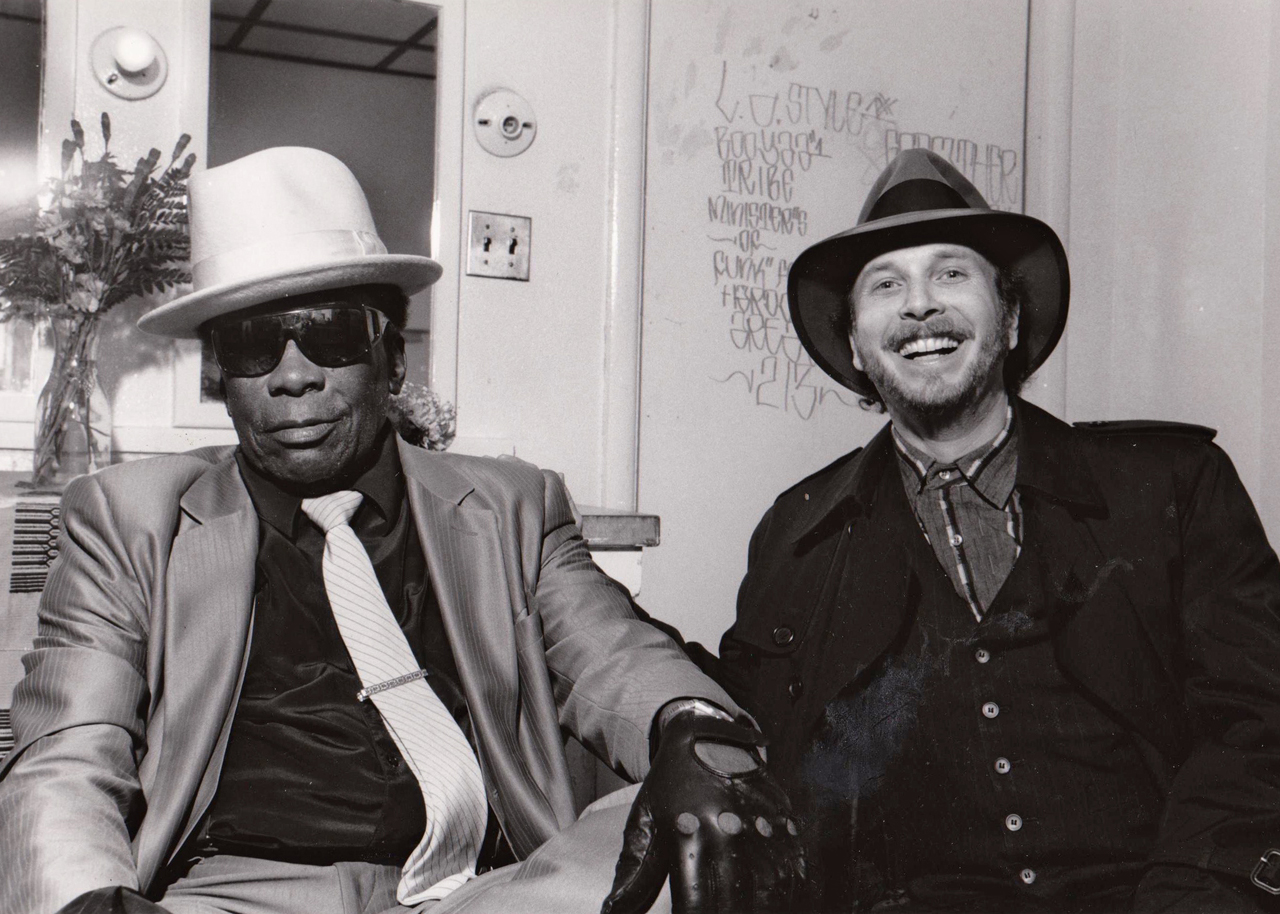
Yes, but before that I worked with Luther Tucker, but just played local gigs. Luther never really hit the road. Then in ’82 I joined Hooker’s band.

Was it kind of daunting to work for an already established act like Hooker?

Naw. Not at all. It felt real comfortable. I was steeped in John Lee’s music, and I was hired to play in his band. I actually met him at the first gig in Detroit with the band. I can see where it might seem formidable, but I knew his music, and was so steeped in that stuff that I was excited about it, and I didn’t see it as a daunting task.

Everybody who has played with Hooker has stories to tell.

John really knew the power of his music. For me, the story about John Lee Hooker is that he is one of the few men I’ve ever met that was so in touch with himself. He could move people across the board with his music. And he knew it. He knew the power of that. He respected it.

And he could draw upon that source anytime he felt like it. He didn’t always feel like it, maybe. But anytime he felt like it, he could get down as deep as you can get. I saw him do it in the studio when I was producing him. On gigs, the hush of the crowd that was, you know, boisterous and drinking and having a good time, all of a sudden you could hear a pin drop. Very few cats can do that.

You’ve been touring for three decades. Does the fire still burn? Does it feel as new as when you first started?

Maybe the travel gets old, but not the gigs. I can truthfully say that. There’s nothing better than when you’re playing in front of a crowd. Whether it’s a small club, a festival, a big club – it doesn’t matter. There’s nothing like that communication that can happen between a performer and an audience. That will never get old. If that ever gets old, you better give it up.

Every gig is still like waking up in the morning, saying, “I’m alive. It’s a new day. It’s a new audience.” You give it your best shot. You never rest on your laurels. Ever. That’s the worst possible thing a performer can do. And you always stretch it.

A lot of people ask me, “How do you produce a record?” And I say, “good question.” Ask about a hundred different producers and you get a hundred different answers.

While performing, do you still transcend the moment, leave civilian Roy Rogers behind, and transform into something bigger onstage?

That’s the allure of the live performance. You’re always going for that, and that’s something that doesn’t happen all the time. Nor could it happen all the time. Yes, that’s what you’re striving for. That’s an intangible thing. How does that happen? I hope that always remains the secret. I hope nobody unlocks that key or has a microchip that says this is what will get you there.

You’ve been touring for more than 30 years. How has the concert industry changed during the past three decades?

Dramatically. You had a fundamental change, not only in the powers that be, but local promoters, festival sponsorship, how people approach certain festivals in certain musical ways. You had a contraction, certainly, of people who were marginal … and now they’re out.

But I think, in general, the concert business is still healthy, because people will always go out and see live music. I think the contraction of it, though, has lessened, in some degree, the breadth and variety of music that’s available for people to listen to.

Even with the Internet, it’s a big thing. It’s harder for people to advertise and get their music out there. They still have to go through the same type of difficulties of staging a show or advertising a club. How are they going to define the audience?

We have the baby boomers that have grown up, and now you have the younger generation that has a different type of music. So, how does a club define what audience they’re going to draw? Can they draw an audience? It’s really defined on where you are and where you’re at.

You have to have a game plan. You’ve got to define what you’re going for. That’s really a big change. But in reference to any kind of artist, it’s more calculated in a way. It was a little looser. Economics define that, in a large part.

There are fewer radio stations. If you compare the amount of radio stations playing music today. I couldn’t quote the numbers, but it’s got to be 10 to 1.

Maybe if you’re talking about terrestrial radio, but there’s Internet and satellite.

There is satellite radio, but not everybody gets satellite radio. And with Internet radio, you have to know what you’re looking for. I think that’s going to come on strong.

In reference to concerts, it was much more ‘out there,’ if you will, in a non-defined way. I’m not saying it was better, necessarily. That’s just a dramatic way in how you promote things.

But blues has always spread through word-of-mouth, with fans discovering and telling other fans about new music. And the Internet boosts that experience to the 12th power where word-of-mouth is a global connection.

That’s still going to happen. It’s very similar. It’s on a grander scale. Like taking a record and saying, “check out this guy.”

  • Caution: Fingers Working

    "Every gig is still like waking up in the morning, saying, “I’m alive. It’s a new day. It’s a new audience."

    Add |

You’ve worked with people who are not considered blues musicians – Sammy Hagar, Linda Ronstadt – is there a pop record you’re on that nobody associates with you? Like a secret hit, because you played on somebody else’s record that shot up the charts?

Speaking of Sammy, when he left Van Halen, he wrote a song called “Little White Lies,” and I was on that recording, and that was a pretty good size rock hit for him. I don’t think people realize that I’m on that record.

I get a lot of calls and comments about a soundtrack that was just a real blessing to be on. There was a movie a few years back. Actually it [the soundtrack] was nominated for a Grammy. It’s called Hot Spot. That was with Miles Davis, John Lee Hooker, Taj Mahal and myself. A lot of people don’t know about that, but the people who do say it’s one of their favorite soundtracks. The movie was with Don Johnson and Virginia Madsen. The movie is OK. The soundtrack is superb.

Dennis Hopper was the producer. He wanted to have his favorite jazz musician – Miles Davis – and his favorite blues musician – John Lee Hooker. Basically, Taj and I were in support of those guys. If you check it out, you would dig it.

What can you tell us about your new album, "Split Decision?"

It’s got a lot more edge than my previous albums. I went for a different kind of sound. Guitar-driven stuff. It’s a normal, Roy Rogers eclectic mix of songs and material, I’ll tell you that. I’ve never been a straight-ahead blues guy. I wrote and recorded all the songs.

I do a duet with Ottmar Liebert, which is slide and flamenco, which is kind of cool. It’s got my band rocking away. You gotta have those big grooves to have what you want to do, song wise.

We got a saxophone on this record. George Brooks, a very good jazz saxophonist plays on a couple of tunes that are instrumentals. I did an all-instrumental record a few years back – Slideways – that was kind of cool to explore without vocals.

So I did a combo play. But I think overall, it’s got an edge. I wanted to tell more stories, songwriting wise, not your average boy-meets-girl kind of thing. I wanted to explore some new topics and songwriting wise, it’s taken it to another place for me. It really comes out of the sounds. There are lots of guitars.

  • Roy Rogers

    "I still think in terms of a complete album. I don’t think in terms of tracks. The sequence is super important in a recording for me. The overall sound and how the sounds go together."

    Add |

I still think in terms of a complete album. I don’t think in terms of tracks. The sequence is super important in a recording for me. The overall sound and how the sounds go together – I’m very conscious of that. Always have been as to how the record comes together.

It’s like when you used to put a record on. It takes you on a journey where you’re going somewhere. You have the ups and downs of what you’re listening to. Hopefully, you’re in a better spot in the end, musically. I really approach it in that way.

You go in with a certain idea in your mind. It always changes in the studio. You put the things together, and you say, “Yeah, that sounds great.”

But you gotta go in with a plan. You just don’t say, “Let’s record a bunch of tunes.” That’s not me.

Do you layer tracks? Do you work in the studio with a full band?

I work with a full band and layer afterwards. Always cut the tracks live, with basics, then layer the guitar parts. I play a range of guitars, so it’s always how they go together.

You’re known for taking several guitars on the road. How many do you have onstage?

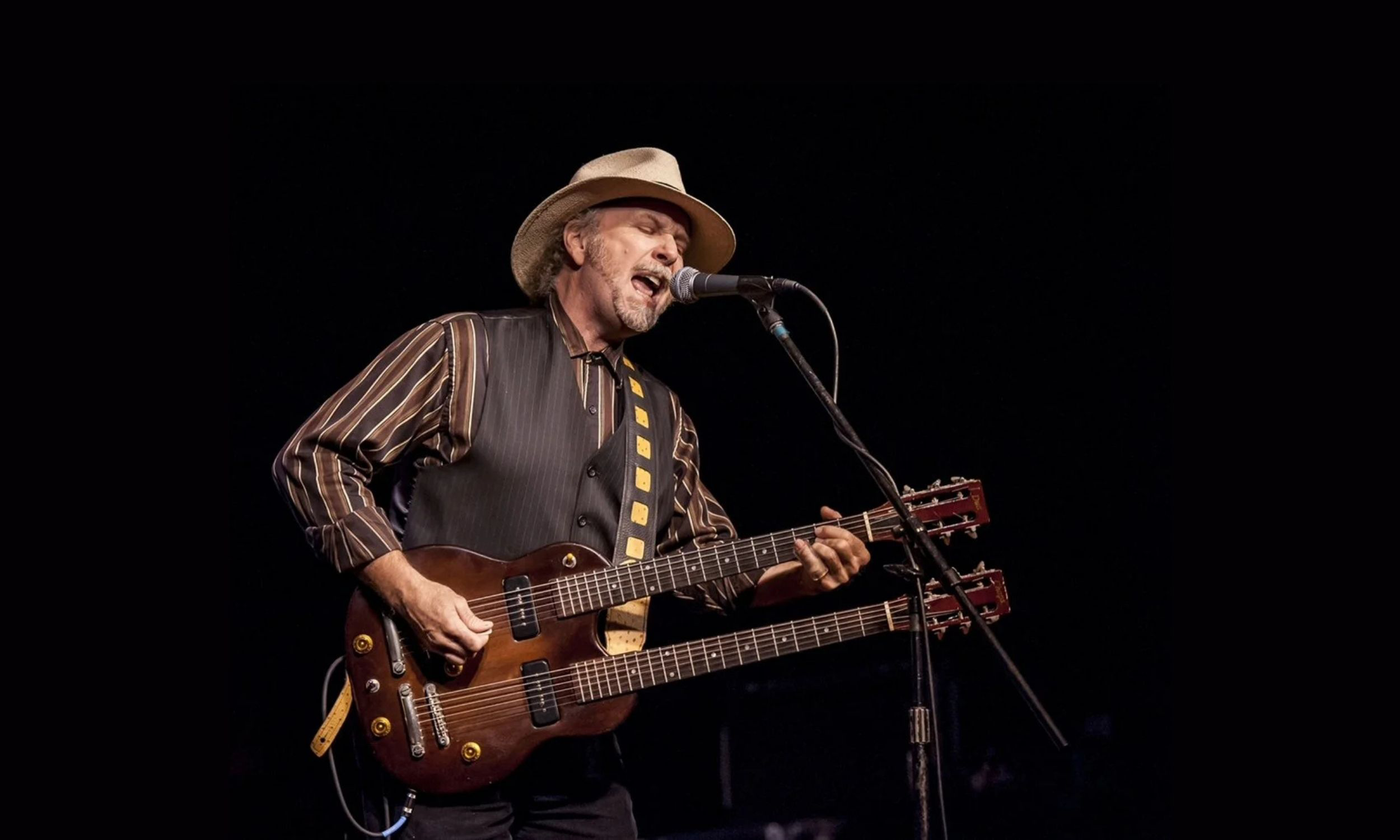
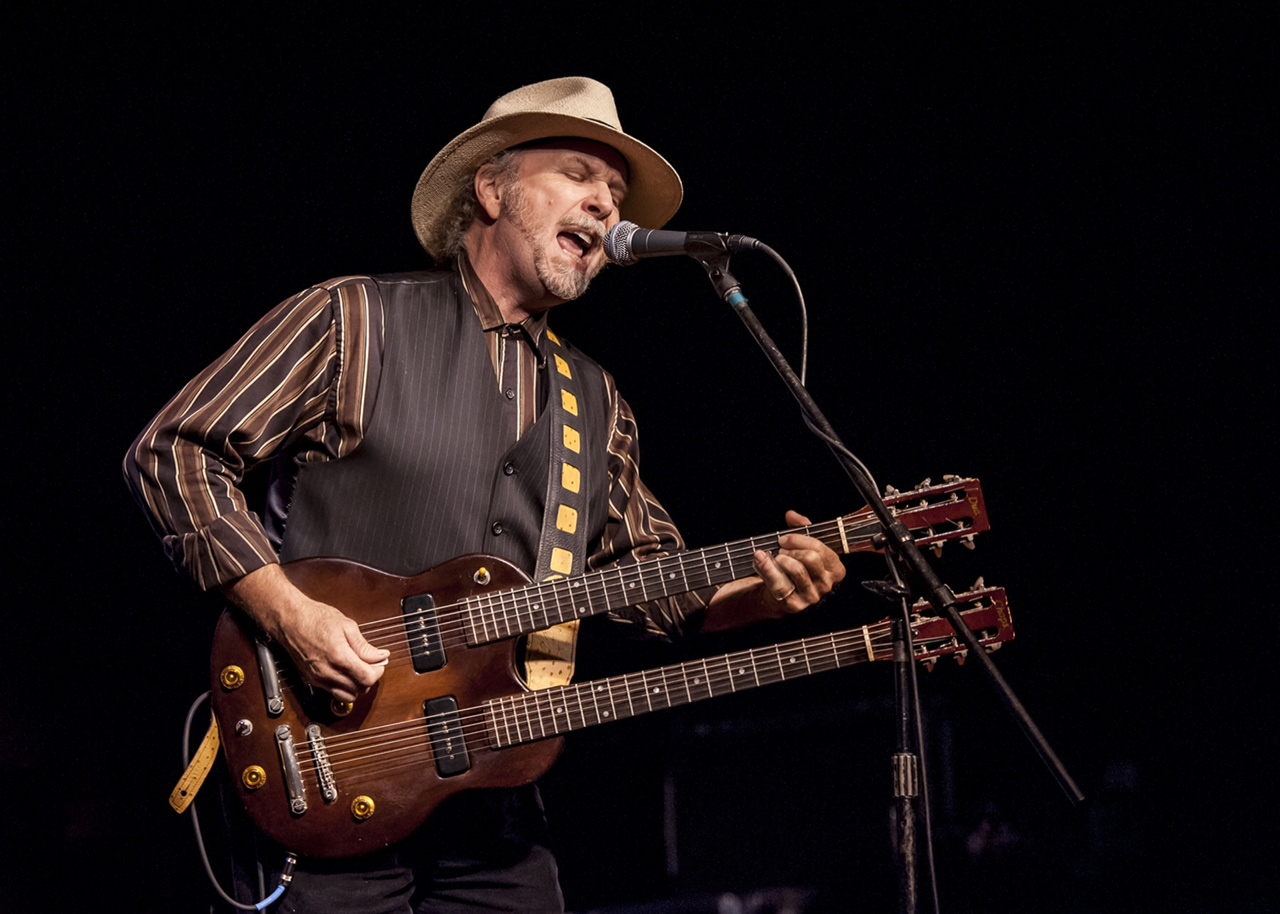
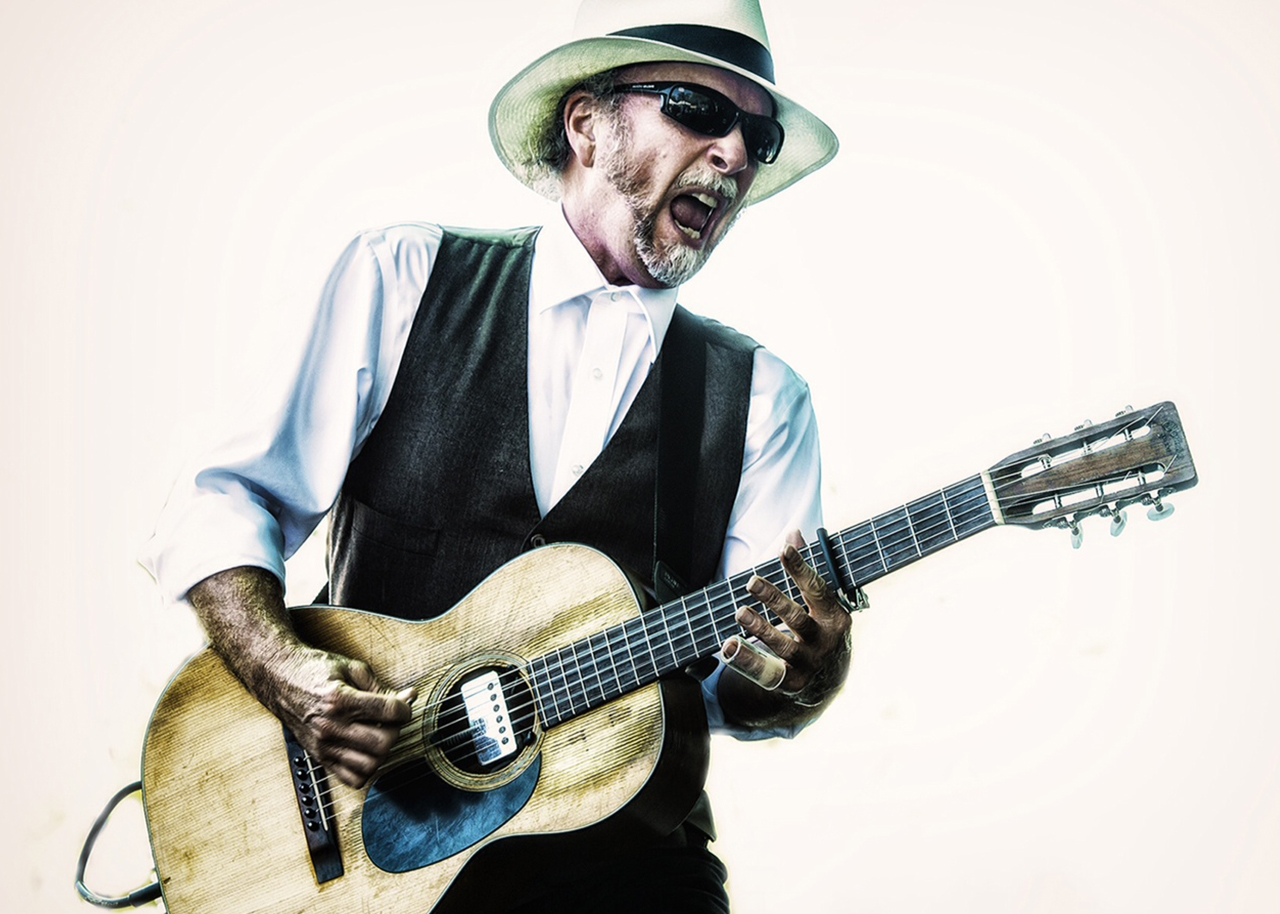
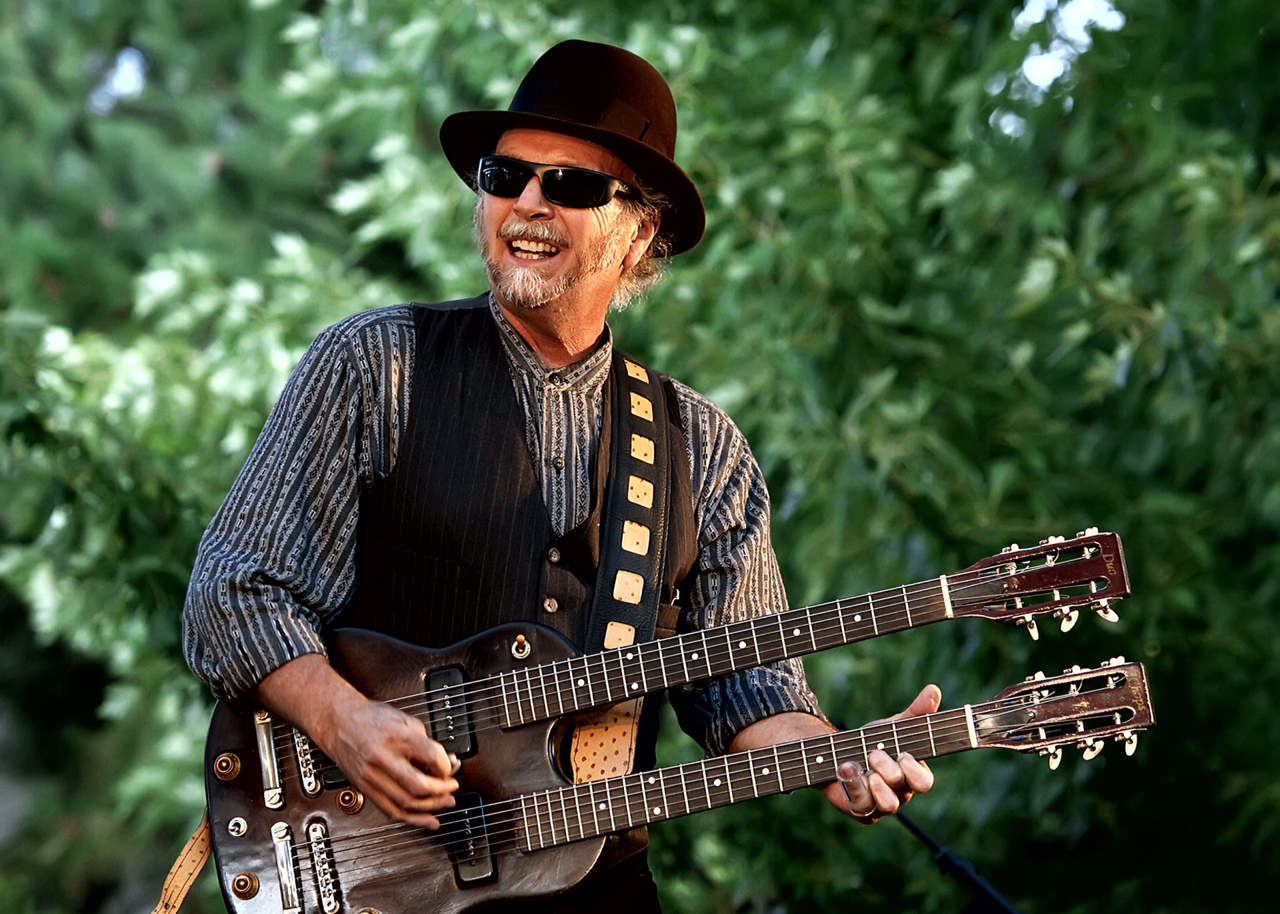
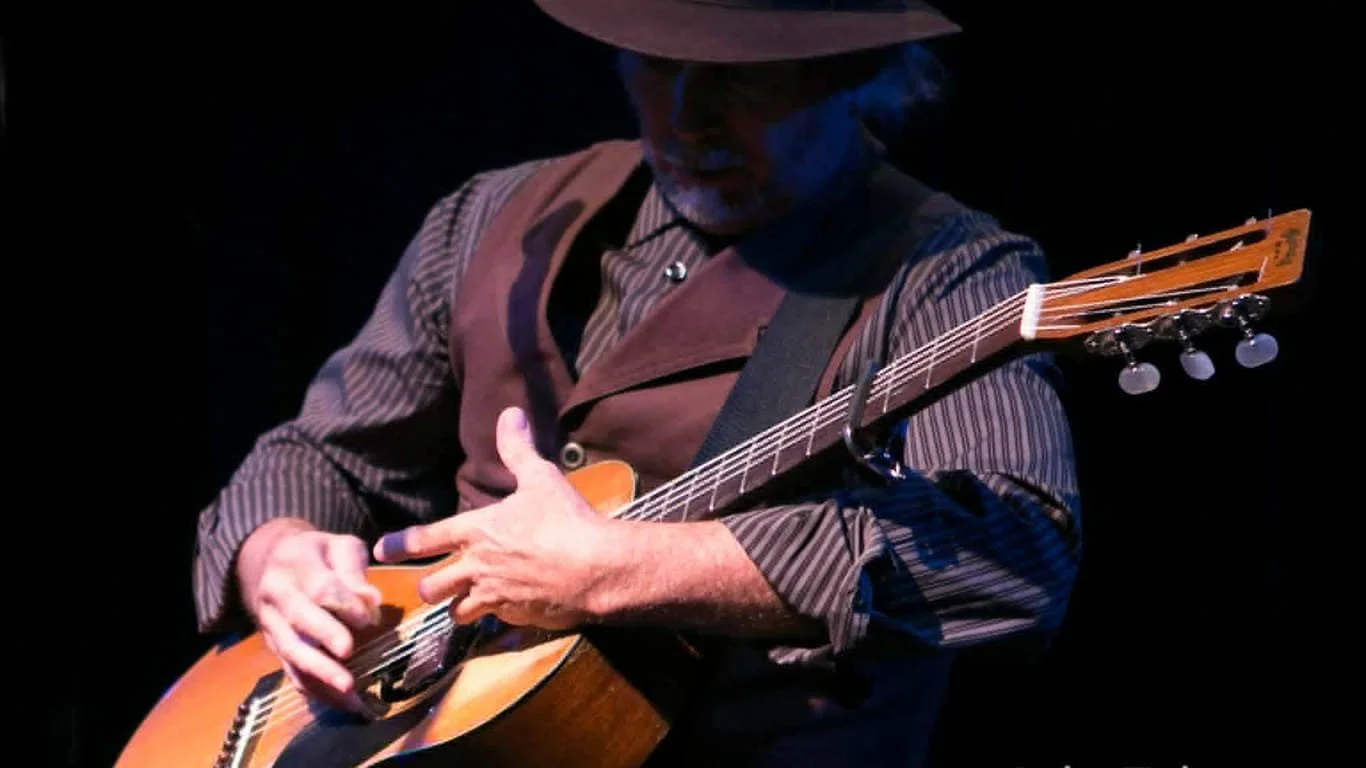
Usually a minimum of three, but anywhere from three-to-five. I always have a 12-string with me. These days I’m playing a double-neck, which is all over the record. Of course, the signature Martin 0-16 New Yorker. I guess you could call that my signature axe. That’s what I’m know for. Playing that little guy.

You started playing guitar when you were 12. When did you start to sing?

I started to sing when I was 13. I was really lucky. My guitar teacher was a guy in Vallejo by the name of Joe Wagner. Knew R&B music and knew a lot about blues. Loved Johnny “Guitar” Watson. He’s saying, “This is Freddie King. This is Johnny ‘Guitar’ Watson.” Of course, I had no clue as to who these guys were.

Lo and behold, I get into a band the next year. I’m talking about a little eighth grader, 13-years-old, and I’m playing in a high school band with 16-year-olds who are driving cars. It was a fast learning experience.

Did you ever lie about your age so you could play a nightclub gig?

Only one time, but I was much older. I wasn’t 21 yet and we got a gig at a nightclub. I didn’t have a fake I.D. – the guy just said, “you’re hired.”

What’s a Roy Rogers road trip like?

I keep it pretty simple. Whether it’s overseas or the States, I travel light. It’s a trio. Steve Ehrmann on bass has been with me a long time, a dear friend of mine. On drums is Billy Lee Lewis, formerly of Tommy Castro Band. Billy’s been playing with me for five years.

We keep it light, we travel light. We travel as a trio, plus my road guy, Ralph, whether I’m flying or not. We don’t have a big bus. We have a small van, although I do fly to a lot more gigs than just hitting the road like we used to. That’s another change. It’s not cost-effective to hit the road, so to speak, for long periods at a time, with the economy as it is.

I’m not playing as many small clubs these days. I keep it real compact, we run a tight ship, and we let ‘er rip.

How did you land in Nevada City?

I lived in the Bay Area most of my life. I still love the Bay Area, and I still wanted to be close to the Bay Area, but I didn’t want to live there because it just got too crowded for me. My kids are grown. My daughter just graduated from college. My son is 33. We didn’t have the kids at home anymore. We said, “what’s a good place where we can still be close to the Bay Area, but enjoy the outdoors?”

Nevada City – you’re close to Tahoe, the Bay Area and other places. I love living up here – the clean air and everything that goes with it. It’s great to come home off the road, fly into Sacramento airport, then come up here to the big trees. I’m very fortunate to be able to have done this. We moved here two years ago and have not looked back.

What’s next for Roy Rogers?

I’m thinking of doing a Christmas record. I’m thinking about orchestrating it in a way that would be way different. Guitar with some type of orchestration. It would definitely be left of standard.

Are you thinking of doing standards? Are you considering some obscure Christmas songs, or writing a Christmas song?

All of the above. Secondary do that, I’m thinking of doing a record of standards, but in a bluesier direction. To me, Gershwin can be bluesy. I think it would be fun to do that.

What would you tell a 12-year-old Roy Rogers just picking up the guitar today?

Have fun playing. It’s not fun to begin with. That comes later. But you gotta have fun to peak your interests in something. Especially when you’re a kid.

They never had to tell me to practice. I loved the guitar. I loved practicing. When I got into a band it was like, “Wow! What was that?” All these guys are playing together.

The next thing I would say is play with other people. Find other people to perform and rehearse with. We can reach all the analogies we want about performance, about touring, about interacting with people – it really comes down to that. You can be the best-doggoned player on the planet, but if you’re there in your own little room, who cares? You have to communicate and music is a means of communication.

I don’t want to get philosophical on you, but that’s what I would tell the kid. Have fun to begin with, then settle down and work at it, and then learn it to wherever you want to take it. Listen to all kinds of music. Don’t just listen to one kind of music. The more music you listen to, as we know, the more you realize music is so interrelated. You don’t know that to begin with, but you’ll learn it when you listen to different kinds of music. That would be my advice.

Click here for Roy Rogers' official Web site.


Split Decision
Slide guitarist Roy Rogers has been described as playing riffs that “could peel a crawfish.” Pretty nice (and accurate) compliment for the Redding-born musician who’s made a name for himself not only for his great slide playing, but also for his singing and songwriting, and for producing albums for music icons John Lee Hooker and Ramblin’ Jack Elliott. Rogers’ band, The Delta Rhythm Kings, joins him on his latest album, Split Decision, an eclectic collection of original tunes. [Read More...]